
Korean Chuseok Highway Traffic — When a 4-Hour Drive Takes 9 Hours
Korean Chuseok highway traffic turns a Seoul-Busan trip into a 9.5-hour crawl. 6.16 million cars, jam-packed rest stops, and the ritual that defines Korea's biggest holiday.

The drive from Seoul to Busan took nine and a half hours last Chuseok. Nine. And. A. Half. That's a route that normally clocks in around four hours—give or take—suddenly stretched to more than double. Welcome to Korea's Chuseok highway traffic, where everyone knows what's coming, everyone dreads it, and yet everyone still hits the road.
6.16 Million Cars in One Day — Holiday Traffic Congestion at Scale
According to domestic media reports, the first day of this year's Chuseok holiday saw 6.16 million vehicles on Korea's expressways. That's 510,000 cars heading from the Seoul metropolitan area to the provinces, and 380,000 going the opposite direction—all at once. Traffic peaks between 11 a.m. and 1 p.m., then doesn't really clear until 8 or 9 p.m. These aren't just transportation statistics. They're a window into what "holiday" actually means in Korean society.
The Gyeongbu Expressway saw stop-and-go traffic stretching more than 90 kilometers—from the Singal Junction through Suwon, Giheung, all the way to the Nami Junction. The Jungbu Expressway wasn't much better, with crawling speeds from Hanam down past Icheon. Hours trapped inside a car. And yet, inside those cars, people unpack snacks they brought from home, tune into the radio, hand tablets to restless kids, and find ways to endure. Korean Chuseok highway traffic is inconvenient, sure. But it's also a rite of passage, almost comforting in its predictability.
Why People Still Make the Trip — The Cultural Weight of Going Home
Chuseok isn't just time off work. It's the gathering of family. It's ancestral rites (charye). It's eating hometown food together around one table. For a huge portion of the Korean population, these rituals still carry real weight. In a country where most people live in Seoul and its surrounding sprawl, the holidays are when that concentration temporarily reverses. Families scattered across Busan, Daegu, Gwangju, Mokpo—they all converge back home. And the only way to get there is through those highways.
People leave even when they know the traffic will be brutal because the trip isn't purely transactional. The conversations in the car, the walnut cookies and fish cakes at the rest stop, the countryside rolling past the windows—it's all part of the journey. Holiday traffic congestion is frustrating, yes. But it also reveals how Korean society still prioritizes "family" and "home" in a way that can't be optimized away.
Rest Stops — The Comma in a Long Sentence
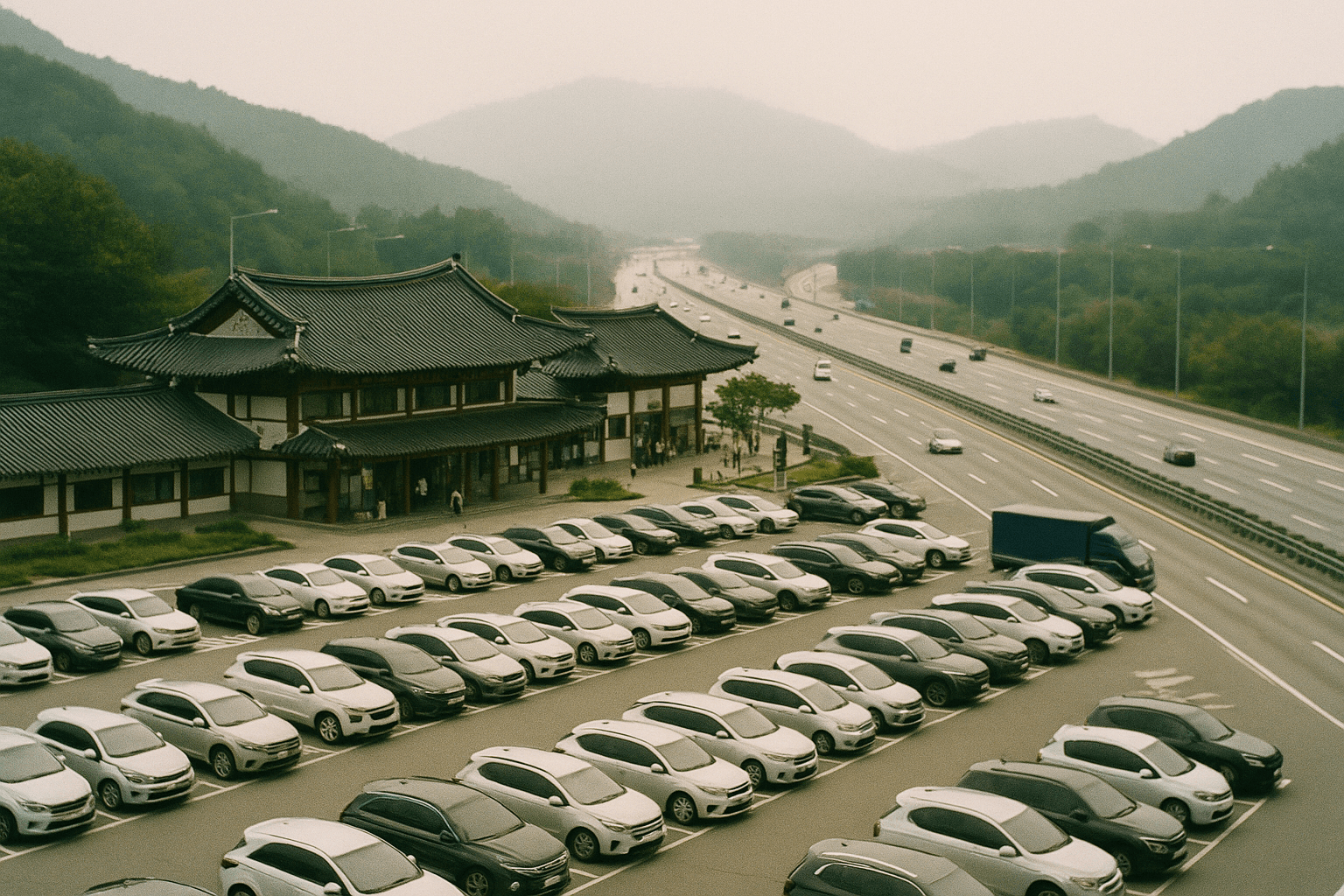
Highway rest stops are landmarks of the Chuseok exodus. The worse the traffic, the more packed the parking lots, the longer the bathroom lines. And still, people pull over. Stretch their legs. Sip hot fish-cake broth. Let the kids pick out snacks at the convenience store. Rest stops aren't just pit stops—they're mini-events embedded in the holiday travel experience.
These days, rest stops have become destinations in their own right. Local specialty booths, bakeries that went viral on social media, limited-edition souvenirs. You stop because you're stuck in traffic, and you end up discovering something unexpectedly delightful. Those little moments stack up, turning the drive from a race to the finish line into a journey worth remembering.
The Future of Holiday Travel — Hints of Change
In recent years, Chuseok travel patterns have started to shift. More people are splitting up their vacation days. Some families have flipped the script entirely, with parents visiting their kids in the city—what's known as "reverse migration." Younger generations especially are loosening their grip on traditional homecoming rituals. And yet, millions of cars still flood the highways. That stubborn traffic is proof that the symbolic meaning of the holiday hasn't faded.
Train and bus ridership is creeping up, but cars still dominate. There's the convenience of door-to-door travel, the ability to haul all your luggage and gifts, and, maybe most importantly, the privacy of your own family bubble on wheels. All of that keeps the Chuseok highway traffic alive and well.
For more stories about Korean culture and everyday life, check out K-Blog.
The Ritual Endures — Even at 9.5 Hours
Next year, it'll probably look the same. Cars leaving the night before. Headlights snaking down the expressway at dawn. People shaking off drowsiness with gas-station coffee at a rest stop. This is the Chuseok landscape in Korea. Inefficient? Yes. Exhausting? Absolutely. Annoying? Sometimes. But it keeps happening.
Because inside that crawl is love for family, longing for home, and the rare chance to take a real break. Korean Chuseok highway traffic isn't just a road. It's a physical manifestation of values Korea still holds dear. The longer the jam, the clearer those values become.
Frequently Asked Questions
- When is Korean Chuseok highway traffic the worst?
- Traffic typically peaks on the first day of the holiday between 11 a.m. and 1 p.m., when the bulk of cars leave the Seoul metro area for the provinces. It doesn't really clear up until around 8 or 9 p.m.
- How can you avoid holiday traffic congestion in Korea?
- Leave very early in the morning (before 5 or 6 a.m.) or late at night (after 10 p.m.) for lighter traffic. Some people also travel a day early or a day late. That said, family schedules often make flexibility tough.
- What should you eat at a Korean highway rest stop?
- Walnut cookies (hodugwaja) are a classic. Hot fish cakes with broth, corn dogs, and soft-serve ice cream are also hugely popular. Lately, each rest stop has been developing signature menu items, so it's worth doing a little research before you stop.
- Is reverse migration actually becoming common in Korea?
- Traditional homecoming (kids traveling to their parents' hometowns) is still the norm by far. But reverse migration—parents visiting their kids in the city—is slowly growing, especially among younger families with small children who want to reduce travel stress.